Role-based access control
Giving permissions to job roles, then putting people in roles, instead of one by one.
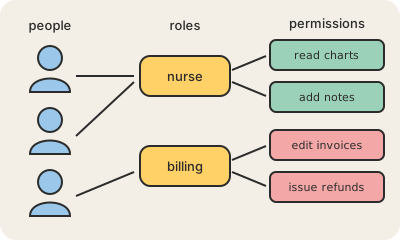
Role-based access control, or RBAC, organizes who can do what around roles that mirror jobs: "nurse", "billing", "admin", "read-only auditor". Permissions (read patient charts, issue refunds, delete users) are attached to the role, and people are assigned one or more roles. When Ana joins billing, she gets the billing role and instantly has exactly what her colleagues have. When she moves to another team, swapping the role removes the old access.
The alternative, granting permissions person by person, works for five employees and turns into chaos at five hundred. People pile up access as they change jobs, nobody remembers why someone can export the customer database, and audits become archaeology. RBAC makes the question "who can touch payroll?" answerable by looking at one role. It also makes least privilege practical: each role gets only what that job needs.
You meet RBAC everywhere: the "Viewer", "Editor" and "Owner" levels in a shared document, admin consoles in business software, Kubernetes roles, and cloud permission systems like IAM. NIST published a reference model in the early 2000s that became a standard. Its weak spot is rigidity: when rules depend on context ("only patients in your own ward, only during your shift") teams either create dozens of nearly identical roles or move to attribute-based access control (ABAC), which decides using properties of the user, the resource and the moment.
Keep in mind
- Permissions go to roles; people get roles.
- Changing jobs means swapping roles, not editing dozens of grants.
- It makes least privilege and audits manageable.
- When rules depend on context, ABAC is the usual next step.
Go deeper
- Role-based access control on Wikipedia
- Role Based Access Control project (NIST)
- Authorization Cheat Sheet (OWASP)