PostgreSQL
A free, open-source relational database behind a great many apps.
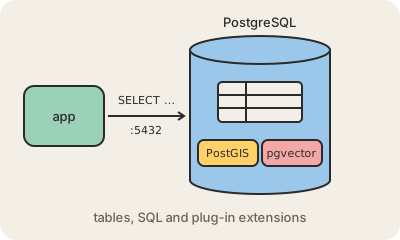
PostgreSQL, usually just called Postgres, is a relational database: it stores data in tables with rows and columns and lets you ask questions in SQL. It is open source, free to use for any purpose, and maintained by a community of developers and companies rather than a single vendor.
It started as the POSTGRES research project at the University of California, Berkeley, in the 1980s, and took its current name in the 1990s when it gained SQL support. Its reputation rests on being careful with data: transactions either happen completely or not at all, and many people can read and write at the same time without stepping on each other. It also goes beyond plain tables, with support for JSON documents, full-text search and geographic data.
A big part of its popularity is extensions, add-ons that teach it new tricks. PostGIS turns it into a map database, and pgvector lets it store embeddings for AI search. Cloud providers offer it as a managed service, such as Amazon RDS and Aurora, so teams get Postgres without running the server themselves. For many new projects it is the default choice: if you are not sure which database to use, Postgres is rarely the wrong answer.
Keep in mind
- Open-source relational database, queried with SQL.
- Born as a research project at UC Berkeley in the 1980s.
- Extensible: PostGIS for maps, pgvector for AI embeddings.
- Offered as a managed service by every major cloud provider.