Correlation vs causation
Two things moving together does not mean one of them causes the other.
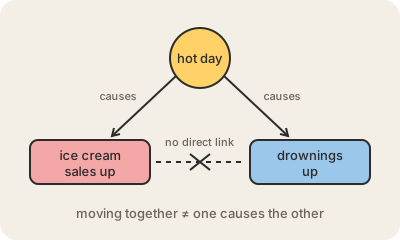
Correlation means two things tend to move together: when one goes up, the other usually goes up too (or down). Causation means one actually produces the other. The classic warning "correlation does not imply causation" exists because our brains jump from the first to the second far too easily.
The textbook example: in summer, ice cream sales and drownings both rise. Ice cream does not make people drown. A third thing, hot weather, sends more people both to the ice cream shop and to the pool. That hidden third factor is called a confounder, and it is the most common trap. Other traps: the arrow may point the other way (sick people take more medicine, which does not mean medicine makes people sick), or the link may be pure coincidence, which happens a lot when you compare enough unrelated numbers.
This matters every time someone reads a chart. "Users who use feature X stay longer" may only mean that loyal users explore more features. The reliable way to show causation is an experiment where chance decides who gets what, like an A/B test or a clinical trial. When an experiment is not possible, statisticians use careful methods to rule out confounders, and they still speak with caution.
Keep in mind
- Correlation: two things move together. Causation: one produces the other.
- A hidden third factor (a confounder) is the usual explanation.
- The cause can also run backwards, or the link can be a coincidence.
- Randomized experiments, like A/B tests, are the solid way to show cause.