Reserved instances and Savings Plans
Cheaper cloud prices in exchange for promising to keep using it for one or three years.
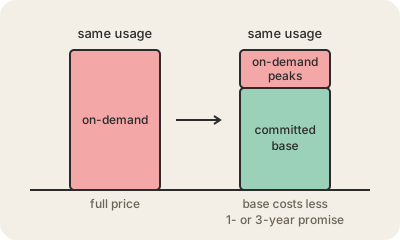
Cloud servers are normally billed on demand: you pay by the hour or second and can stop whenever you want. That freedom costs extra. If you already know you will need a certain amount of computing for a long time, providers give you a lower price in exchange for a commitment. On AWS there are two main ways to make it: Reserved Instances and Savings Plans.
A Reserved Instance is a discount tied to a specific kind of machine, for example one EC2 instance type in one region, for one or three years. A Savings Plan is more flexible: you promise to spend a fixed amount per hour, say 10 dollars, and everything you use up to that amount gets the cheaper rate. Compute Savings Plans apply whatever the instance type or region, and also cover Fargate and Lambda. AWS advertises savings of up to roughly 72% compared with on-demand, with bigger discounts for three-year terms and for paying up front.
The catch is that you pay the commitment whether you use it or not. If your app shrinks, moves to another service, or you simply overestimated, the money is spent anyway. The usual approach is to commit only to the steady base you are sure about, and leave the peaks to on-demand or spot instances. Azure calls its version reservations and also sells savings plans; Google Cloud calls them committed use discounts.
Keep in mind
- A lower price in exchange for a one- or three-year commitment.
- Reserved Instances lock in a machine type; Savings Plans commit an hourly spend.
- You pay the commitment even if you stop using it.
- Commit to your steady base, not to your peaks.
Go deeper
- Savings Plans (AWS)
- Reserved Instances for Amazon EC2 (AWS docs)
- What are Azure Reservations? (Microsoft Learn)