Reasoning model
An AI model that works through a problem step by step before it answers.
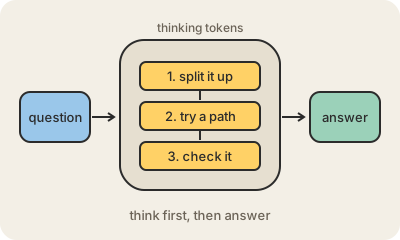
A reasoning model is an LLM trained to think out loud before replying. Instead of producing the answer right away, it first writes a long chain of intermediate steps: it breaks the problem apart, tries an approach, checks the result, and backs up when something does not add up. Only then does it write the final answer.
The idea took off in late 2024 with OpenAI's o1, followed by DeepSeek-R1, Claude with extended thinking and others. These models are usually trained with reinforcement learning on problems whose answers can be checked, like math or code that has to pass tests, so the model learns which ways of thinking actually lead to correct results.
The gain is real on multi-step work: math, programming, planning, puzzles, careful analysis of a long document. The cost is also real: all that thinking is made of tokens, so answers take longer and cost more. Many APIs let you set a thinking budget, and for a quick question or a simple rewrite a regular model is often the better choice.
Keep in mind
- Writes intermediate reasoning before the final answer.
- Usually trained with reinforcement learning on checkable problems.
- Better at math, code and multi-step tasks; slower and pricier.
- Thinking tokens are billed, so many APIs let you cap them.
Go deeper
- Reasoning language model on Wikipedia
- Extended thinking (Anthropic docs)
- Reasoning models (OpenAI docs)