OLED
A screen where every pixel makes its own light, so black is truly off.
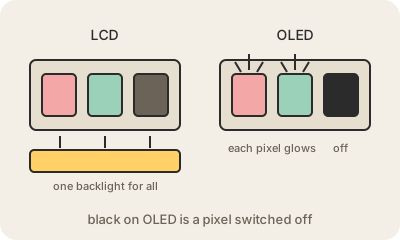
Most screens for years were LCDs: a white light shines from behind, and a layer of tiny shutters lets more or less of it through each colored pixel. An OLED (organic light-emitting diode) screen works differently. Each pixel is made of a material that glows by itself when electricity runs through it. There is no backlight at all.
That changes a lot. A black pixel on an OLED is just switched off, so blacks look truly black, even in a dark room, and contrast is very high. Screens can be thinner and even bend, which is how foldable phones exist. And a dark background actually saves battery, because off pixels use no power. Most high-end phones, many smartwatches and a growing number of TVs and laptops use OLED; Samsung calls its version AMOLED.
The trade-offs: OLED is more expensive to make, and the glowing material slowly wears out with use. If the same bright image stays in the same place for a very long time, like a TV channel logo, it can leave a faint permanent ghost, called burn-in. Modern screens shift pixels and dim static elements to make that rare.
Keep in mind
- Each pixel produces its own light; there is no backlight.
- True blacks and very high contrast, because black pixels are off.
- Thinner and flexible, which makes foldable phones possible.
- Can suffer burn-in if a bright static image stays on for very long.