Multi-agent system
Several AI agents splitting one job, each with its own role, instructions and tools.
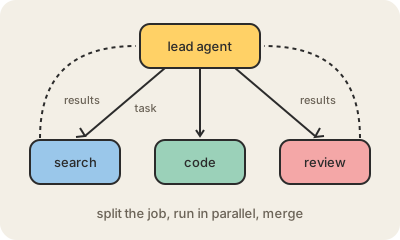
A multi-agent system is a setup where several AI agents work on the same task instead of one agent doing everything. Each agent is usually an LLM running a loop of thinking and calling tools, but with its own instructions, its own tools and its own context window. One might search the web, another write code, another check the result.
The most common pattern is an orchestrator with subagents: a lead agent breaks the job into pieces, hands each piece to a subagent, and combines what comes back. Because the subagents can run in parallel and each one starts with a clean context, the team can cover more ground than a single agent whose context fills up with everything it has read. Other designs pass the work along a pipeline, or have one agent review another's output.
The cost is real. Anthropic, describing the multi-agent setup behind Claude's research feature in 2025, reported that it used roughly 15 times more tokens than a normal chat, and that it paid off mainly on broad tasks that split into independent parts. Agents can also misunderstand each other, repeat work or pass errors along, and a bug is harder to trace across several conversations. Tasks where every step depends on the last one, like much of coding, often go better with one well-equipped agent.
The idea is older than LLMs: researchers have studied multi-agent systems for decades in robotics, traffic simulations and games. What is new is that each agent can now read, write and reason in plain language.
Keep in mind
- Several agents, each with its own instructions, tools and context.
- Typical shape: an orchestrator that delegates to subagents running in parallel.
- Good for broad tasks that split cleanly; overkill for tightly linked steps.
- More agents means many more tokens, and so more cost.
Go deeper
- How we built our multi-agent research system (Anthropic)
- Multi-agent system on Wikipedia
- What is a multi-agent system? (IBM)