Data mesh
An organizational approach where each business team owns and publishes its own data.
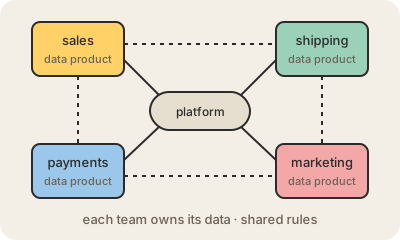
A data mesh is a way of organizing who does what with data in a large company, more than a piece of technology. In the classic setup, every department sends its data to one central data team, which builds the data warehouse or data lake for everyone. As the company grows, that team becomes a bottleneck: it is far from the business, it does not know what each field really means, and every request waits in its queue.
The idea, described by Zhamak Dehghani around 2019, rests on four principles. Domain ownership: the team that runs a part of the business (sales, shipping, payments) also owns its data. Data as a product: that team publishes datasets other teams can rely on, with documentation, quality guarantees and someone accountable. Self-serve platform: a central platform team provides the shared tools so each domain does not reinvent storage, pipelines and catalogs. Federated governance: common rules on security, privacy and formats, agreed together and enforced automatically.
Data mesh makes the most sense for big organizations with many teams and mature engineering; for a small company, one good central team is usually simpler. It is often confused with a product you can buy, but no tool gives you a mesh. Tools like a data catalog, dbt or a shared warehouse can support it; the hard part is changing responsibilities and incentives.
Keep in mind
- Each business domain owns, documents and serves its own data.
- Datasets are treated as products, with users, quality guarantees and an owner.
- A central platform provides shared tools; governance rules are common.
- An organizational model for large companies, not a product you install.
Go deeper
- Data mesh principles (Zhamak Dehghani, martinfowler.com)
- What is a data mesh? (AWS)
- Data mesh on Wikipedia