Churn
The customers who leave, and how fast they do it.
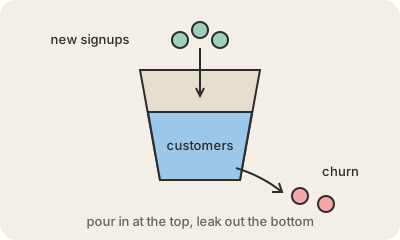
Churn is the share of customers who stop being customers over a period: they cancel a subscription, close an account, or just stop showing up. If a streaming service starts the month with 1,000 subscribers and 50 of them cancel, its monthly churn rate is 5%.
Churn matters most in businesses that live on recurring payments: phone plans, gyms, software subscriptions, streaming, banks. Winning a new customer usually costs money in ads and discounts, so every customer who leaves early is money spent for nothing. A business with high churn has to run faster and faster just to stay the same size, like filling a bucket with a hole in it.
Measuring it sounds simple but has traps. You have to decide what counts as leaving (a cancellation, or 30 days with no activity?) and over what period. Data teams look at churn by cohort to see whether newer customers stay longer, and build models that predict who is likely to leave, so someone can step in with a call, a fix or an offer before they go. The opposite number, the share who stay, is called retention.
Keep in mind
- The share of customers lost over a period, usually per month or year.
- Its opposite is retention: the share who stay.
- Critical for subscription businesses, where keeping customers is cheaper than winning new ones.
- The definition of "leaving" has to be agreed before the number means anything.