AWS account and billing
What an AWS account is, how you get charged, and how to avoid a surprise bill.
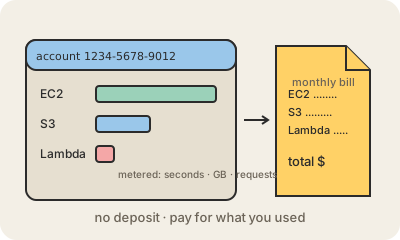
An AWS account is the container for everything you create in AWS: it has a twelve-digit id, an email, a root user that can do anything, and one monthly bill. Companies usually have many accounts (one per team or per environment, like test and production) grouped under AWS Organizations, so a mistake in one does not touch the others and each one's cost is visible on its own.
Billing is pay as you go: no upfront payment, no contract. Each service is metered in its own unit: Amazon EC2 by the second an instance runs, Amazon S3 by gigabyte stored and gigabyte sent out, AWS Lambda by request and millisecond. At the end of the month everything is added up and charged to your card. Prices vary by Region, and sending data out of AWS to the internet is the line people most often forget to budget.
New accounts get a Free Tier: a starter allowance to try many services at no cost, within limits, plus small always-free quotas on services like Lambda and Amazon DynamoDB (the exact rules change, so check the current ones). The important habit: set a budget with an email alert on day one, because a forgotten instance or a public bucket serving a viral file keeps metering while you sleep. For steady workloads, Savings Plans and Reserved Instances cut the price in exchange for a one- or three-year commitment.
Keep in mind
- One account means one bill, one root user and one set of resources.
- Everything is metered: seconds, gigabytes, requests. Nothing is flat-rate.
- Set a budget alert the day you open the account.
- Steady workloads get discounts through Savings Plans or Reserved Instances.