Software testing
Checking that software does what it should, mostly with code that tests other code.
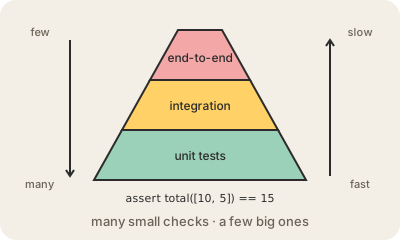
Software testing is everything done to find out whether a program works before its users do. Some of it is manual: a person clicks through the app looking for problems. Most of it, in modern teams, is automated tests: small programs that call the real code with known inputs and check the result. A test might say: "total([10, 5]) must return 15". If someone later breaks that, the test fails and tells them.
Tests come in layers. Unit tests check one small piece, like a single function, in milliseconds. Integration tests check that pieces work together, for example the code and a real database. End-to-end tests drive the whole app like a user would, opening a browser and clicking buttons; they are the most realistic but also the slowest and most fragile. The usual advice, called the test pyramid, is many unit tests, fewer integration tests and a handful of end-to-end ones.
The main value is confidence to change things. A good test suite runs automatically on every change in the CI pipeline, catching regressions, old features broken by new code, within minutes. Tests are not proof of correctness, though: they only check the cases someone thought of. As the computer scientist Edsger Dijkstra put it, testing can show the presence of bugs, never their absence.
Keep in mind
- Automated tests are code that runs your code and checks the results.
- Unit, integration and end-to-end tests trade speed for realism.
- They run on every change, so broken features are caught early.
- Passing tests mean the checked cases work, not that there are no bugs.