Haptics
Technology that talks to your sense of touch with taps, buzzes and resistance.
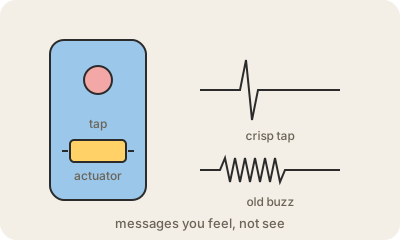
Haptics is technology that communicates through touch. The simplest example is your phone vibrating in your pocket. Modern haptics goes much further: short, precise taps when you flick a toggle, a soft click when a timer wheel passes each number, or a different rhythm for a message than for a call. The goal is to make glass and plastic feel like they respond to you.
Most of it comes from a small motor inside the device. Old phones spun a tiny off-center weight, which gives a loose, mushy buzz. Newer devices use a linear actuator, a mass that moves back and forth on a spring and can start and stop in a few milliseconds, so it can draw sharp, distinct patterns. Apple's Taptic Engine is one; it is also how many laptop trackpads fake a click without actually moving. Game controllers like the PlayStation 5 DualSense use haptics to let you feel rain or gravel, and add triggers that push back.
Good haptics matter more than they seem. They confirm an action without you looking, help people with low vision, and make virtual buttons feel trustworthy. Developers can trigger and design patterns through the phone's system tools, and in VR, gloves and vests with haptics try to let you feel the objects you touch.
Keep in mind
- Communicates through touch: vibrations, taps and resistance.
- Linear actuators make crisp, short taps that old spinning motors could not.
- Used in phones, trackpads, game controllers and VR gear.
- Confirms actions without looking and helps accessibility.
Go deeper
- Haptic technology on Wikipedia
- Playing haptics (Apple design guidelines)
- Implement haptics on Android (Android Developers)