AWS Well-Architected Framework
AWS's checklist of good practices for building systems in the cloud that hold up.
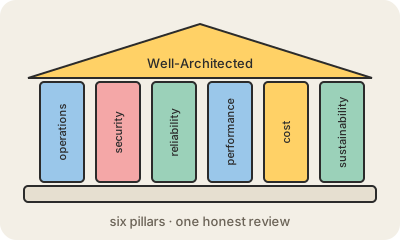
The AWS Well-Architected Framework is a guide, written by AWS from thousands of customer reviews, that describes what a good cloud system looks like and which questions to ask about yours. It is not a product you switch on; it is a set of principles, best practices and questions such as "how do you back up your data?" or "how do you know when something breaks?".
It is organized in six pillars: operational excellence (running and improving the system day to day), security, reliability (recovering from failures), performance efficiency (using the right resources for the job), cost optimization, and sustainability (reducing the environmental impact). The pillars often pull against each other, like reliability against cost, and the framework helps make those trade-offs on purpose instead of by accident.
Teams use it in a Well-Architected review: they go through the questions for one workload, honestly, and end up with a list of risks ranked high and medium, plus an improvement plan. AWS offers the free Well-Architected Tool in the console to run these reviews, and "lenses" with extra questions for specific cases like serverless, machine learning or SaaS. It is also a common language: AWS partners, auditors and certifications all refer to it.
Keep in mind
- Six pillars: operations, security, reliability, performance, cost and sustainability.
- It is guidance and questions, not a service that changes your resources.
- A review produces a list of risks and a plan to fix them.
- The Well-Architected Tool in the AWS console is free to use.